Categorification of some Penrose polynomials
A Penrose-type bracket for ribbon graphs, lifted to doubly and triply graded homologies using Möbius TQFTs and Möbius Frobenius algebras.
Theme song: A very unserious YouTube Short for this serious paper.
Data
- Title: Categorification of some Penrose polynomials
- Authors: Daniel W. Collison and Daniel Tubbenhauer
- Status: preprint from 2026
- Code and (possibly empty) Erratum: GitHub
- arXiv: https://arxiv.org/abs/2607.01632
- Theme song: https://www.youtube.com/shorts/QGTORZ46ISU
- Keywords: Penrose polynomial, graph coloring, four color theorem, TQFTs, categorification, nonorientable cobordisms
Abstract
We construct doubly and triply graded Penrose-type homologies for ribbon graphs. The construction is a TQFT-valued cube of resolutions built from two-dimensional cobordisms, allowing nonorientable ones. Their Euler characteristics recover specializations of some Penrose polynomials; in particular, the four color case comes with a refinement of the classical Penrose criterion.
What is the point?
The Penrose polynomial turns graph coloring and ribbon graph topology into local bracket rules. This paper lifts some of those rules to homology theories: instead of only remembering a polynomial, one constructs chain complexes whose graded Euler characteristics recover Penrose-type invariants.
local Penrose skein relations.
ribbon graphs and nonorientable cobordisms.
homology before Euler characteristic.
Picture
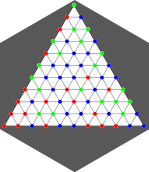
The Penrose polynomial bracket rules used as the visual mascot for the page.
