Positivity in symmetric webs and block permanents
Can pictures prove inequalities for complex matrices? We use symmetric webs to turn a difference of permanents into calculations with squared norms.
Data
- Title: Positivity in symmetric webs and block permanents
- Author: Daniel Tubbenhauer
- Status: Preprint, November 2026.
- Preprint: arXiv:2611.22058 · PDF · LaTeX source
- MSC 2020: Primary: 15A15, 18M30; Secondary: 05E10, 17B10.
Abstract
We use symmetric webs to prove Marcus's block-permanent inequality for up to four blocks of every size, for five blocks of size at least three, and for any fixed number of blocks above an explicit logarithmic bound on the block size.
The proof idea is easy: Bending strands in the Schur relation turns the comparison into a calculation with squared norms.
What is the question?
The permanent is the determinant with all signs positive. Take a Hermitian positive semidefinite matrix \(A\), divided into equal-sized square blocks \(A_{ij}\), and form the smaller matrix \(G=(\operatorname{per} A_{ij})\). Marcus conjectured that \(\operatorname{per} A\geq\operatorname{per} G\).
The smaller matrix \(G\) is itself a Gram matrix. To see this, write \(A\) as a Gram matrix, group its underlying vectors into blocks, and symmetrize each group to make a packet. So the question is really about two different ways of symmetrizing the same packets.
When the entries of \(A\) are nonnegative, counting matchings gives the inequality. For a general complex Gram matrix, individual matching weights need not even be real. That is where the webs come in.
The two pictures
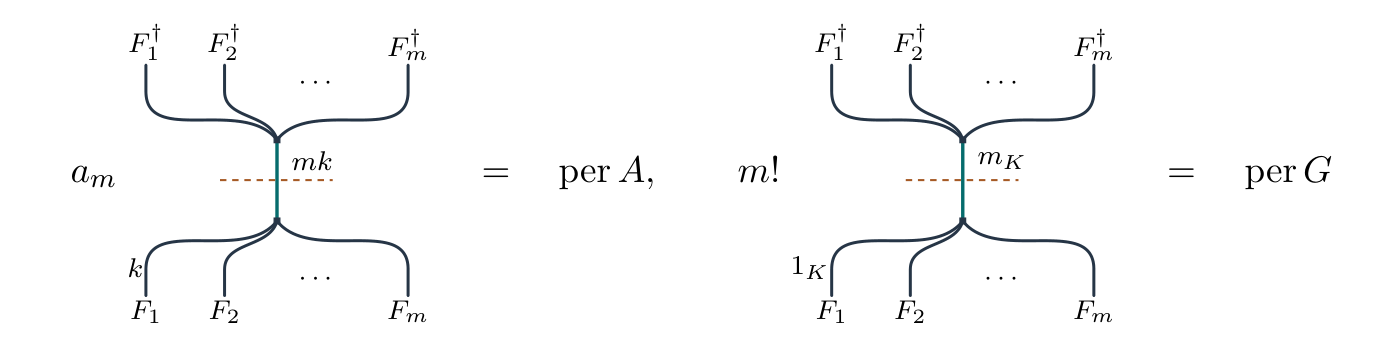
The two closures from the paper. The left one gives the permanent of the original matrix; the right one gives the permanent of the matrix of block permanents. The dashed line indicates where we cut. Click to enlarge.
What the preprint proves
Theorem 1A.1 gives the following bounds. The theorem index links the numbered statements and examples to their Lean proofs.
More precisely, for \(m\geq 2\) blocks of size \(k\), one sufficient condition is
\[2^k-1\;\geq\;\frac{m(m-1)(2m-1)}{6\lfloor m/2\rfloor}.\]
In particular, for any fixed number of blocks, the inequality holds for all sufficiently large block sizes; the required size can be taken to be at most twice the base-two logarithm of the number of blocks, rounded up.
The first example
Let \(A\) be the four-by-four all-ones matrix, divided into four two-by-two blocks. Then \(G\) is the two-by-two matrix with every entry equal to two:
\[\operatorname{per} A=24,\qquad \operatorname{per} G=8,\qquad \operatorname{per} A-\operatorname{per} G=16.\]
Eight matchings respect whole blocks; the other sixteen split them. For general complex matrices, the difference is no longer a simple positive count, but the same distinction survives diagrammatically.
Why symmetric webs?
Replace each block by a symmetric tensor. A clasp averages the orders of the strands in a packet.
Bend a packet and expand the clasp into diagrams that contract different numbers of strands.
A diagram cut into a halfweb and its reflection evaluates to a squared norm. The hard part is arranging the cuts so their coefficients are positive.
Where things stand
The paper treats two, three and four blocks individually, obtains a five-block result for blocks of size at least three, and gives a general logarithmic threshold. The five-block quadratic case and further small block sizes remain open in this approach. One naturally marked web expression can even be negative, so simply repeating the same cut does not settle the remaining cases.
The project started with Temperley--Lieb pictures for two blocks in 2013 and later notes using sl3 webs and higher for more blocks. Based on that, the paper was developed and revised with some ChatGPT assistance. The AI declaration in the introduction gives the details.
Paper and extras
- Preprint: arXiv:2611.22058 · Read the PDF · LaTeX source
- Code: Project repository · Lean verification · Finite computations
- Proof guide: Theorems, lemmas and worked examples
- Theme song: TBA.